For generations, Mars has captured the imagination of scientists, dreamers, and science fiction writers alike. Today, the idea of humans living on the Red Planet is no longer confined entirely to fiction. Companies such as SpaceX, led by Elon Musk, openly discuss building permanent settlements on Mars within the coming decades. All this when Mars is both promising and dangerous. It is one of the harshest environments humans have ever considered inhabiting.
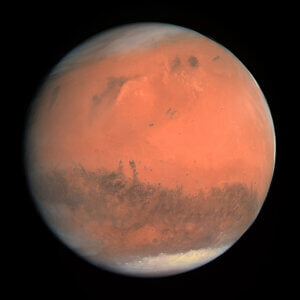
Why Mars Looks so Promising
Mars has several characteristics that make it attractive for future colonization.
First, it is relatively close. Depending on planetary alignment, Mars is roughly 34 million miles from Earth at its nearest approach. While that is still an enormous distance, it is far more reachable than any known exoplanet.
Mars also has a day length surprisingly similar to Earth’s—about 24 hours and 37 minutes. That may sound minor, but maintaining a familiar day-night cycle could help future colonists psychologically and physically.
Scientists have also discovered evidence that Mars once had flowing rivers, lakes, and perhaps even shallow oceans. Frozen water still exists at the poles and beneath portions of the surface. Water is critical because it can potentially provide drinking supplies, oxygen, and even rocket fuel.
Compared to smaller moons or asteroids, Mars also has a meaningful gravitational pull—about 38 percent of Earth’s gravity. That could make long-term human settlement more practical than living in near weightlessness.
All of this makes Mars appear, at least at first glance, like the most realistic candidate for humanity’s first off-world colony.
The Atmosphere Problem
Unfortunately, Mars quickly becomes dangerous once you look more closely.
Its atmosphere is extremely thin and consists mostly of carbon dioxide. Humans could not breathe outdoors, and the atmospheric pressure is so low that unprotected exposure would rapidly become fatal.
Temperatures are another major challenge. Mars is far colder than Earth, with average surface temperatures around minus 80 degrees Fahrenheit. In some regions, temperatures can plunge far lower.
Massive dust storms also sweep across the planet. Some storms grow so large they can cover nearly the entire world for weeks at a time.
Any future settlers would need sealed, pressurized habitats simply to survive.
Solar Radiation: The Invisible Threat
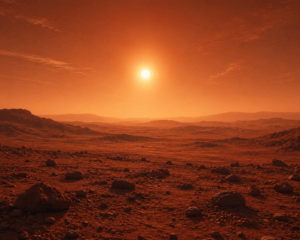
One of the greatest dangers on Mars is something humans cannot even see.
Unlike Earth, Mars lacks a strong global magnetic field. Earth’s magnetic field helps shield us from harmful solar radiation and cosmic rays. Mars has little protection.
That means astronauts on Mars would face far greater radiation exposure than people on Earth. Over time, that exposure could increase cancer risks and potentially damage organs, the nervous system, and even human DNA.
Because of this, some scientists believe future Martian habitats may need to be built underground or covered with thick layers of soil for protection. That is one reason why, in the early books of the Host Saga, Van Childs chose to accept underground living for Guardian Force beneath Olympus Mons.
The Human Body Was Built for Earth
Mars also presents another major unknown: low gravity.
At only 38 percent of Earth’s gravity, the human body would likely undergo major changes over time. Scientists already know that astronauts living aboard the International Space Station experience muscle loss and reduced bone density even in carefully controlled conditions.
No one yet knows how decades—or generations—of life in lower gravity might affect human health.
Could children born on Mars develop normally? Could humans eventually adapt? At this point, nobody truly knows.
Elon Musk and the Push Toward Mars
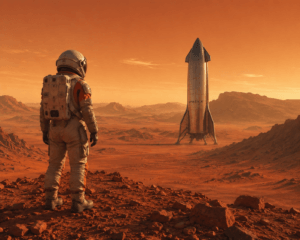
Despite these dangers, Elon Musk continues to advocate strongly for Mars colonization. His company, SpaceX, is developing the massive Starship launch system with the long-term goal of transporting large numbers of people to Mars.
Musk has often argued that humanity should become a “multi-planetary species” to improve long-term survival. Supporters see this vision as bold and inspiring. Critics point out the enormous technical, financial, and medical challenges still standing in the way.
Both sides agree on one thing: reaching Mars is hard. Living there permanently may be far harder.
Final Thoughts
Mars represents both hope and danger.
It may be the best world available for future human expansion, yet it remains profoundly hostile to life as we know it. Colonizing Mars would require extraordinary advances in engineering, medicine, agriculture, and human resilience.
Still, the dream persists. Perhaps that is why Mars continues to appear so often in science fiction. It symbolizes humanity’s enduring desire to explore new frontiers—even when those frontiers are dangerous.
Update
I realize that I haven’t posted for a while. That is because, from February through early April, I had multiple procedures in the OR. Not life-threatening, just procedures designed to repair some issues the tumor caused prior to eradication. Still, they sucked energy, and it seemed like I had appointments every other day. I was tired and did not feel normal. Now, however, I feel back on track, with energy building every week.

I have resumed work on Defiance and am at the 30k-word mark (about a third of the way through). Today I have been choreographing the second set of battle scenes in space and on the planet. It feels good to start writing again.