When most of us think about pollution, we picture plastic floating in the ocean, chemicals entering rivers, or trash accumulating in landfills. But do we think space debris is a big problem?
We probably don’t look up.
But perhaps we should.
More than sixty years of spaceflight have left an enormous amount of debris orbiting Earth. Dead satellites, discarded rocket stages, fragments from collisions, and countless smaller pieces of hardware are traveling around our planet at tremendous speeds.
Most of them are far too small to see from the ground.
That doesn’t make them harmless.
In fact, space debris may eventually become one of the biggest obstacles to humanity’s continued expansion into space.
There Is a Lot of Junk Up There
Since the beginning of the Space Age, thousands of rockets have carried satellites, spacecraft, and people into orbit. Not everything that went up came back down.
Some satellites simply stopped working. Rocket stages remained in orbit. Equipment was accidentally released. Satellites collided or broke apart, producing thousands of additional fragments.
Today, for example, space-surveillance networks track about 40,000 objects in orbit. Roughly 11,000 of those are active payloads, leaving tens of thousands of tracked objects that are no longer performing a useful function.
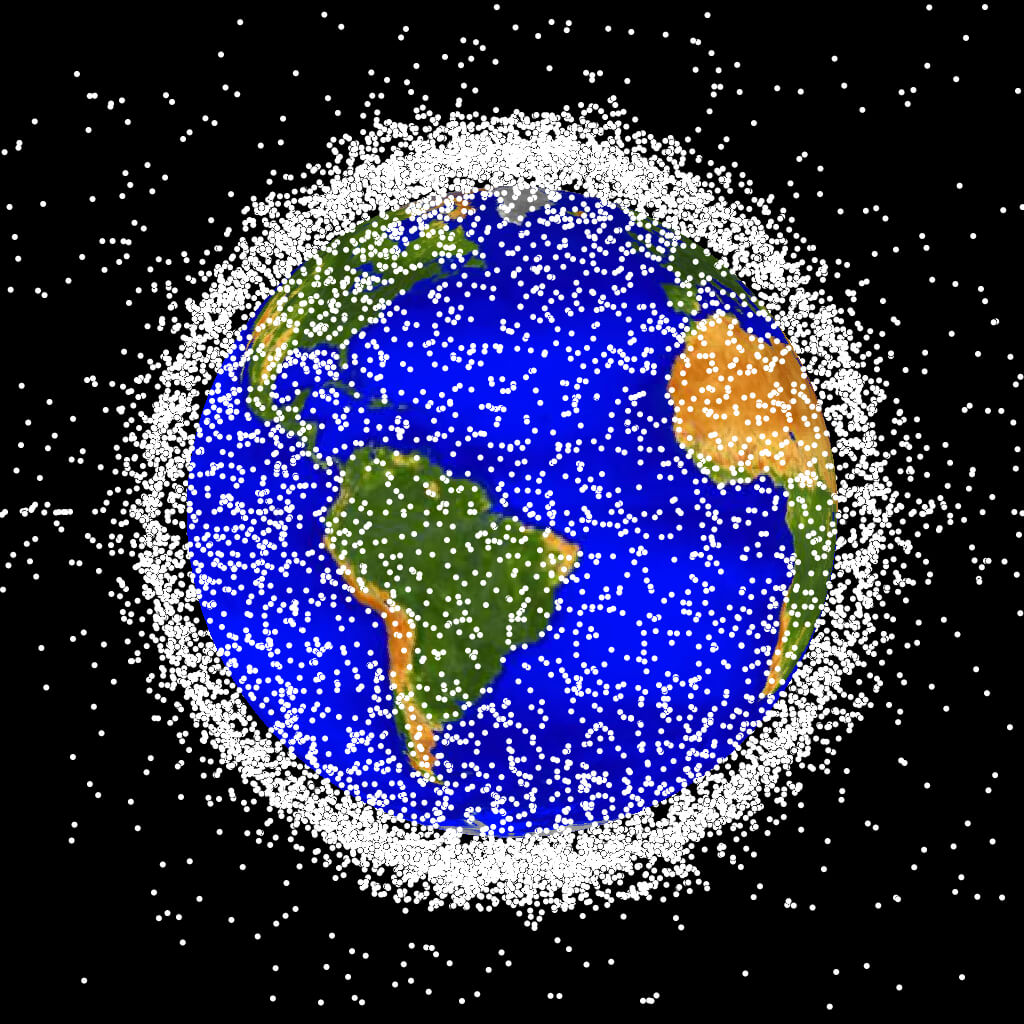
Low Earth Orbit (LEO) within the region of space within 2,000 km of the Earth’s surface.Credit: NASA ODPO.
But that number tells only part of the story.
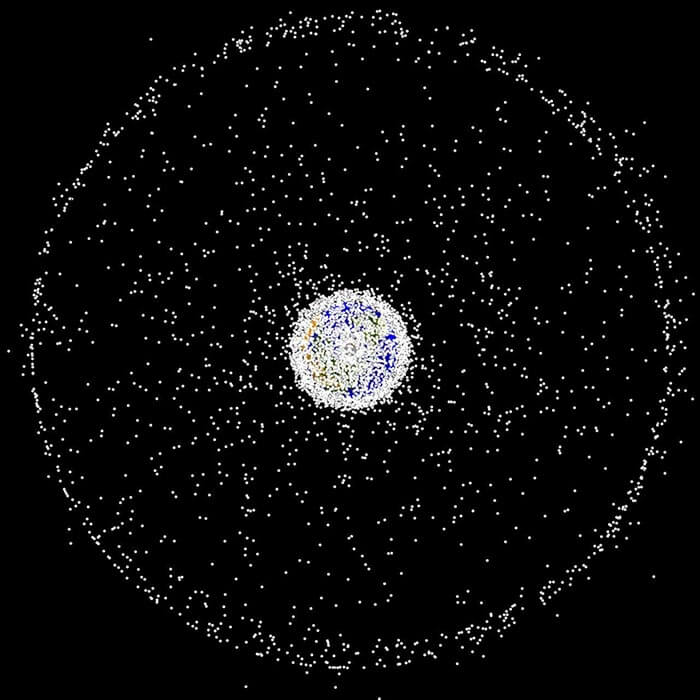
From a vantage point above the north pole, showing the concentrations of objects in LEO and in the geosynchronous region. Credit: NASA ODPO.
The European Space Agency estimates that there are more than 1.2 million pieces of space debris larger than about four-tenths of an inch (1 centimeter) orbiting Earth. Most are too small to be individually tracked, but they are large enough to seriously damage—or even destroy—a spacecraft.
And there are millions more pieces smaller than that.
That creates a serious problem because something doesn’t have to be large to be dangerous in space.
A Tiny Object Can Cause Enormous Damage
Imagine a small piece of metal weighing only a few ounces.
On Earth, you could pick it up and put it in your pocket.
In orbit, that same object might be traveling at more than 15,000 miles per hour.
At those speeds, even a small fragment can strike with tremendous energy. A piece of debris only a fraction of an inch across can damage spacecraft surfaces. Larger objects can penetrate protective shielding, destroy equipment, or disable a satellite.
That means astronauts don’t have to worry only about colliding with another spacecraft.
Something as mundane as a bolt can become a dangerous projectile when orbital velocity is involved.
And there is another complication.
You can’t simply slam on the brakes and move out of the way.
Avoiding Debris Isn’t Easy
Modern spacecraft and satellites can sometimes maneuver around known debris.
The International Space Station has performed avoidance maneuvers when tracking systems predicted that an object might pass dangerously close. Satellite operators can do the same thing if their spacecraft have propulsion systems.
But every maneuver requires planning and usually consumes fuel.
More importantly, you can only avoid something if you know it is there.
Large debris can be tracked. Very small debris generally cannot.
Spacecraft therefore rely partly on shielding to survive impacts from tiny particles. But no practical spacecraft can be armored against every possible collision.
As the amount of material in orbit increases, so does the risk.
The Collision Problem Can Feed Itself
This leads to perhaps the most troubling aspect of space debris.
One collision can create more debris.
Imagine two satellites colliding at orbital velocity. Instead of producing two disabled spacecraft, the collision might produce hundreds or thousands of fragments.
Those fragments continue orbiting Earth.
Some could eventually collide with other satellites, creating still more debris.
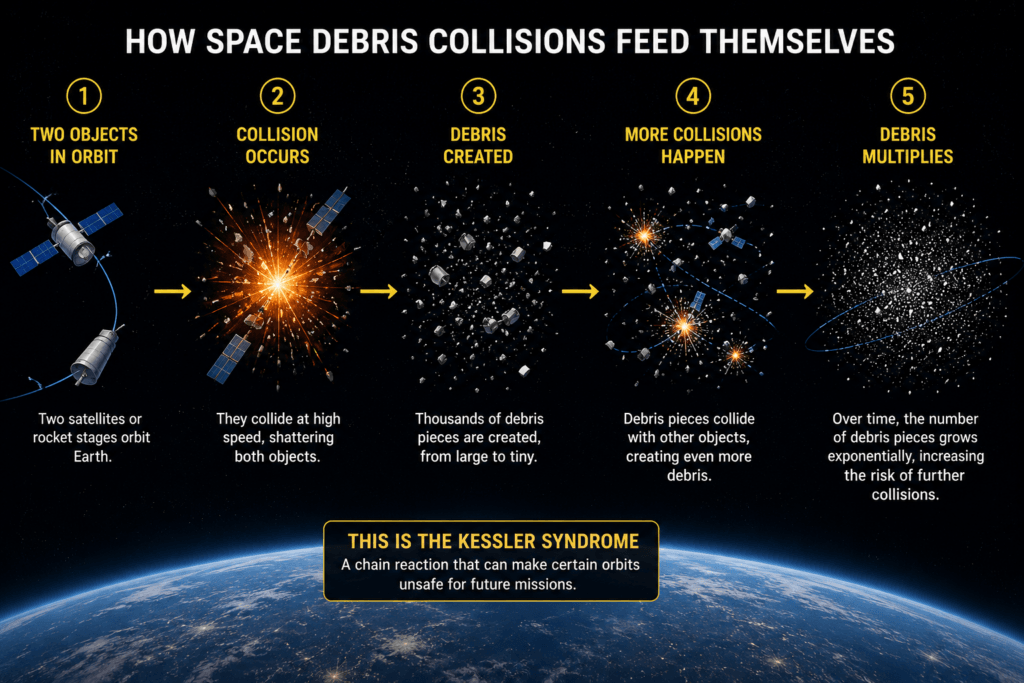
Scientists have studied the possibility of a chain reaction sometimes called the Kessler Syndrome, named after NASA scientist Donald Kessler, who helped describe the danger.
If enough objects accumulate in certain orbital regions, collisions could begin creating debris faster than natural processes remove it.
We aren’t at the point where Earth is surrounded by an impenetrable wall of junk. But the underlying problem is real.
And the more satellites we launch, the more carefully we must manage it.
Why Not Just Clean It Up?
That sounds simple.
Send up a spacecraft and collect the garbage.
Unfortunately, orbital cleanup is enormously complicated.
Every object has its own orbit, altitude, speed, and direction. A cleanup spacecraft cannot simply fly from one piece of debris to another as though collecting trash along a highway.
Changing orbits requires energy and fuel.
There are also thousands of objects worth removing.
Engineers have proposed several solutions. Robotic spacecraft might capture dead satellites and push them into lower orbits where atmospheric drag eventually causes them to burn up. Other concepts involve nets, robotic arms, specialized tethers, or systems designed to accelerate the natural decay of an object’s orbit.
But all of these approaches cost money.
And that raises the inevitable question:
Who pays to clean up something nobody owns—or something another country put there decades ago?
The Future Depends on What We Do Now
The good news is that we understand the problem.
New satellites can be designed so that they leave orbit after completing their missions. Rocket stages can be managed more carefully. Satellites can carry enough propulsion to move themselves into safer disposal orbits or deliberately reenter the atmosphere.
Eventually, active debris removal may become a normal part of operating in space.
It may have to.
Humanity is entering a new era of space activity. Governments are launching new missions. Private companies are deploying large satellite constellations. Plans are developing for permanent operations around the Moon and eventually farther into the solar system.
But access to space begins with getting safely through the region surrounding Earth.
For decades, we treated that region as though it were practically unlimited.
It isn’t.
Space may be unimaginably large, but the useful orbital highways around Earth are not.
And after sixty years of leaving our trash along those highways, we are beginning to discover an old lesson in a very new environment:
Eventually, somebody has to clean up the mess.
UPDATE
For those of you who are wondering, I am currently at 72,000 words in Defiance. That is over half way through. I’m plugging away. Somebody recently told me that after Chemo treatment, your red blood cell count takes a while to build back up, and that can mean being more tired than normal. Perhaps that is an excuse. 🙂
Finally, our 10-plus-year-old dog Jake passed away a few months ago. On a whim, I decided to break the mold of only having Labs. So we are now the owner of a 6-month-old black German Shepherd. Yes they come in black! And, like all my past female dogs, I named her Monday!