Science fiction is full of strange aliens (many humanoid aliens), faster-than-light travel, and galaxies teeming with life. But if you’ve read my Records of the Argos series — or nearly any space opera — you’ve probably noticed something curious: most of the aliens walk upright, have two eyes, and use tools like we do. They’re, well… familiar. They are humanoid.
And while my books include the brutal Arkon and other unique species, many of the beings Nick Hall and his crew encounter share a basic humanoid form. Why? Because there’s solid reasoning behind this — enter convergent evolution.
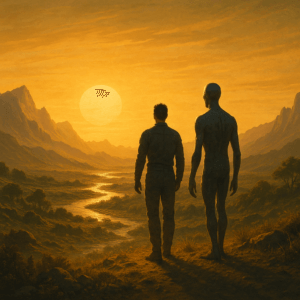
In real-world biology, convergent evolution happens when different species, unrelated genetically, develop similar traits because they’ve adapted to similar environments. Birds and bats both fly, but their wings evolved differently. Dolphins and sharks have similar bodies, but one’s a mammal and the other a fish. Nature finds efficient solutions — and reuses them.
In the Argos universe, planets with Earth-like gravity, atmospheres, and light levels tend to produce life forms that are optimized for those conditions. Upright posture? Great for balance and visibility. Two forward-facing eyes? Perfect for depth perception. Hands with opposable thumbs? Excellent for manipulating tools — and firing plasma cannons.
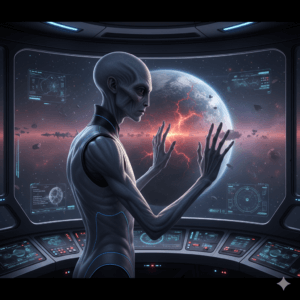
However, reaching those alien worlds requires breaking another rule of science: the light-speed barrier.
According to Einstein’s theory of relativity, nothing can move faster than light. Yet in science fiction, ships leap across the stars as if the galaxy were a neighborhood. How?
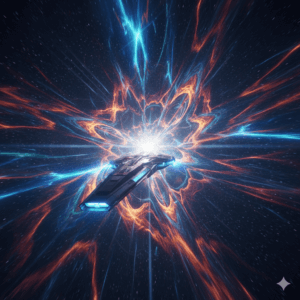
In both of my science fiction series to date, I use Faster Than Light (FTL) speeds — a fusion of quantum physics and speculative propulsion. Think of it like folding space or hopping across dimensions, avoiding the need to travel the distance at all. Real-world scientists have theorized similar ideas, like the Alcubierre Drive, which would contract space in front of a ship and expand it behind. The ship wouldn’t move faster than light — but space itself would.
That idea requires exotic matter and massive energy, but it’s not pure fantasy. It’s physics combined with a dash of imagination.
So, when I write about humanoid aliens and faster-than-light travel, I’m not ignoring science — instead, I’m building from it. I want my readers to think, “Yeah, that could actually work someday.” Because the best sci-fi doesn’t just invent the impossible, it bends what we know into something that might be possible — then dares us to imagine the rest.
What do you think?